
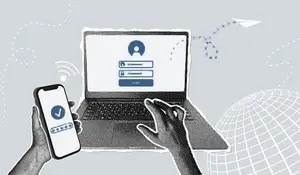
It starts with a simple phone notification.
“Approve sign in?”
The employee glances at their phone during lunch, while driving between appointments, or in the middle of a busy workday. They assume the login request is legitimate and tap “Approve” without thinking twice.
Less than a minute later, a cybercriminal may have full access to the company’s email, files, customer data, or financial systems.
This type of attack is becoming increasingly common, and it is one of the fastest-growing cybersecurity threats impacting businesses today. Known as an MFA push attack or “MFA fatigue attack,” it exploits one of the biggest vulnerabilities in cybersecurity: human behavior.
Even businesses that have implemented multi-factor authentication, often considered one of the most important security tools available, are discovering that attackers are adapting quickly.
What Is an MFA Push Attack?
Multi-factor authentication, commonly called MFA, adds an extra layer of security by requiring users to verify their identity through a second step after entering their password.
This usually involves:
- A push notification
- A text message code
- An authenticator app
- A biometric scan
- A hardware security key
MFA dramatically improves account security because stolen passwords alone are no longer enough for attackers to gain access.
However, cybercriminals have developed new ways to manipulate users into approving login requests themselves.
In an MFA push attack, attackers first obtain a user’s password through:
- Phishing emails
- Data breaches
- Malware
- Credential theft
- Password reuse
Once they have the password, they repeatedly attempt to log into the account. This triggers multiple MFA approval notifications on the employee’s device.
Eventually, some users approve the request either:
- By mistake
- Out of frustration
- Assuming it is a system glitch
- Believing a coworker initiated it
- Wanting the notifications to stop
That single tap can provide attackers with immediate access.
Why These Attacks Are So Effective
MFA push attacks are successful because they target psychology instead of technology.
Most employees have been trained to watch for suspicious emails or bad links. Far fewer are prepared for repeated login prompts that appear legitimate.
Attackers understand that:
- People get distracted
- Employees multitask constantly
- Notification fatigue is real
- Users often trust familiar systems
- Urgency creates mistakes
Over time, repeated notifications can wear people down. This is why these attacks are sometimes called “MFA fatigue” attacks.
In many cases, attackers also combine push notifications with social engineering tactics.
For example, an employee may receive:
- Repeated login requests
- A phone call pretending to be IT support
- A fake Microsoft security alert
- A text message claiming urgent action is needed
The attacker creates confusion and pressure, increasing the chances the employee will approve the request.
Human Error Remains One of the Biggest Cybersecurity Risks
Businesses often focus heavily on firewalls, antivirus software, and technical protections. While these tools are important, human error continues to play a major role in cybersecurity incidents.
Employees are frequently targeted because attackers know people are easier to manipulate than systems.
Simple actions can lead to major consequences:
- Clicking a phishing link
- Reusing passwords
- Sharing credentials
- Approving suspicious MFA prompts
- Downloading malicious attachments
Cybersecurity researchers consistently report that social engineering remains one of the leading causes of successful cyberattacks.
The reality is that most employees are busy. They are trying to respond to emails, answer customers, attend meetings, and complete tasks quickly. Attackers take advantage of those moments of distraction.
Why MFA Still Matters
Despite the rise of MFA push attacks, multi-factor authentication is still one of the most effective cybersecurity protections available.
According to Microsoft, MFA can block the overwhelming majority of automated account compromise attempts.
The problem is not MFA itself. The problem is how attackers are adapting to bypass human decision-making.
Businesses should not abandon MFA. Instead, they should strengthen how it is implemented and supported.
How Businesses Can Reduce MFA Push Attack Risks
Reducing the risk of MFA fatigue attacks requires both technical protections and employee awareness.
Employee Security Awareness Training
Employees should understand:
- What MFA push attacks look like
- That repeated login requests are suspicious
- Never to approve unexpected authentication prompts
- How attackers impersonate IT staff or vendors
Training employees to pause before approving requests can prevent costly mistakes.
Number Matching MFA
Many modern authentication platforms now support number matching. Instead of simply pressing “Approve,” users must enter a matching number shown on the login screen.
This significantly reduces accidental approvals.
Limit Notification Spam
Security systems can often detect excessive failed login attempts and temporarily block repeated MFA requests.
This helps prevent attackers from overwhelming employees with notifications.
Strong Password Policies
Since MFA push attacks begin with stolen credentials, businesses should also focus on:
- Unique passwords
- Password managers
- Password rotation policies
- Monitoring for compromised credentials
Conditional Access Policies
Modern identity management systems can restrict logins based on:
- Geographic location
- Device type
- Risk level
- User behavior
This creates additional barriers even if credentials are compromised.
Small Businesses Are Not Immune
Many smaller organizations assume attackers only target large enterprises. In reality, small and mid-sized businesses are often viewed as easier targets because they may lack:
- Dedicated cybersecurity teams
- Advanced monitoring
- Security awareness training
- Identity management controls
- 24/7 account monitoring
Healthcare offices, law firms, manufacturers, schools, construction companies, and local service businesses have all become common targets for credential-based attacks.
As remote work, cloud applications, and mobile access continue expanding, businesses are relying more heavily than ever on secure authentication systems.
Cybersecurity Is Becoming More Human-Focused
Modern cybersecurity threats increasingly revolve around manipulating people instead of breaking through technical barriers.
Attackers understand that one distracted employee can sometimes provide easier access than sophisticated malware.
This is why businesses are investing more heavily in:
- Security awareness training
- Identity protection
- Endpoint monitoring
- Cloud security controls
- Managed cybersecurity services
- MFA management and monitoring
Technology alone is no longer enough. Businesses also need employees who understand how modern attacks work and how quickly small decisions can create major consequences.
One Tap Can Change Everything
An MFA approval may seem harmless. It takes only seconds.
But in today’s cybersecurity landscape, a single mistaken approval can lead to:
- Email compromise
- Financial fraud
- Ransomware deployment
- Data theft
- Operational downtime
- Reputation damage
As attackers continue evolving their tactics, businesses are being forced to rethink how they approach both cybersecurity technology and employee awareness.
Because sometimes the biggest cybersecurity threat is not a sophisticated hacker breaking through a firewall.
It is a tired employee approving the wrong notification at the wrong moment.